Mayinga's infection and outbreak alert in Kinshasa
The Hot ZoneNurse Mayinga N.'s illness in Kinshasa became the most alarming test of whether the 1976 Ebola outbreak could spread through a crowded city. After caring for Sister M.E., who was gravely ill at Ngaliema Hospital, Mayinga developed symptoms and left work without seeking admission there. For two days she moved through the capital while trying to secure travel papers and find medical help. Her death intensified fear that she might have carried Ebola into public life on a scale that could not be contained. Yet the subsequent search found no infections among the 37 people identified as having face-to-face contact with her. The event joined a frightening possibility to a consequential negative finding: exposure had occurred, but the anticipated chain of urban transmission did not follow.
Illness and Disappearance
Sister M.E. had died after treatment at Ngaliema Hospital, where Mayinga had been caring for her. Mayinga may have been exposed to the nun's blood or other bodily fluids, but the precise route by which she acquired the infection is not established. When headache and fatigue began, she recognized that she was becoming ill but did not immediately accept that it might be the same disease. She came from a poor but ambitious family and had received a scholarship to study in Europe; the possibility that illness would prevent her travel weighed on her decision to get her papers in order before she became visibly sick.
On October 12, 1976, she spent the day waiting at Zairean foreign ministry offices. The following day, feeling worse, she again went into the city rather than reporting to work at Ngaliema Hospital. She took a taxi to Mama Yemo Hospital, where she waited in a crowded casualty ward. A doctor treated her for possible malaria and recommended quarantine, but the hospital had no room in its quarantine ward. Mayinga left by taxi and tried University Hospital, where staff did not identify a clear illness beyond possible malaria. She eventually returned to Ngaliema Hospital and asked to be admitted. There she was placed in a private room and became increasingly lethargic.
The episode was not simply a story of a patient evading care. The account presents a young woman trying to understand an illness whose cause was not yet clear, while worried that acknowledging its seriousness could undo her plans. Her route through several institutions exposed a gap between the need to isolate a suspected case and the practical ability of hospitals to provide isolation. That uncertainty would soon become a public emergency.
From Hospital Case to Citywide Alarm
News that an infected nurse had spent two days moving through Kinshasa spread first through mission networks, government employees, and diplomats, and then reached Europe. Reports of the outbreaks upriver had already generated fear, and Mayinga's case seemed to make the threat immediate: a potentially lethal infection might have been carried through a city of two million people. At the World Health Organization in Geneva, the news prompted a full alert. European governments considered blocking flights from Kinshasa, while officials feared that Mayinga could become the source of a much larger epidemic.
President Mobutu Sese Seko ordered soldiers to guard Ngaliema Hospital and restrict entry and exit to doctors, enforcing quarantine for medical staff inside. He also ordered army units to seal off Bumba Zone with roadblocks and to prevent people from leaving. The Congo River, the region's main link to the outside world, was effectively cut off as riverboat captains refused to stop along the affected stretch despite appeals from the banks. Radio contact with Bumba was lost, leaving officials without reliable information about events upriver. The response therefore extended beyond Mayinga's immediate contacts: it combined hospital isolation in the capital with an attempt to contain the outbreak at its rural source, under conditions of severe uncertainty.
Treatment and Death
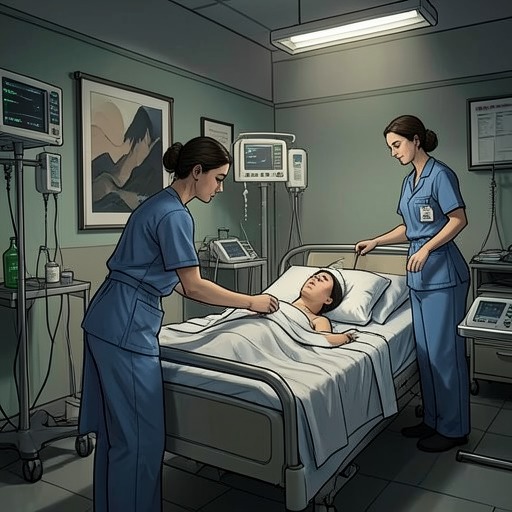
At Ngaliema Hospital, Mayinga was treated by Margaretha Isaacson, a South African doctor. Isaacson initially wore a gas mask but found it increasingly difficult to tolerate in the tropical heat and removed it while continuing to care for Mayinga face to face. Her efforts included giving Mayinga ice to ease her throat, Valium to lessen apprehension, and, as the illness progressed, three transfusions of whole blood. The available care could support Mayinga, but it could not stop the disease.
Mayinga remained conscious and despondent until the final stage of her illness. Her heart developed a rapid, abnormal rhythm, and she died that night of a heart attack. Her death turned the question of her contacts from a precautionary concern into an urgent investigation. The rooms associated with the deaths of Mayinga and the two nuns were contaminated and had remained locked; Isaacson undertook their cleaning after telling staff she would be of little further use in treating patients. The bodies were wrapped in chemically soaked sheets, placed in double plastic bags, and sealed in airtight coffins. Funeral services took place at the hospital under medical supervision, reflecting the effort to handle the dead while limiting further exposure.
Contact Tracing and the Outcome
Medical teams searched Kinshasa for people who had been in face-to-face contact with Mayinga during her time in the city. They identified 37 and confined them in two biocontainment pavilions at the hospital for a couple of weeks. This response treated ordinary proximity as a serious risk while investigators waited to see whether illness would appear. The account notes that Mayinga had even shared a bottle of soda with another person, a contact that could have seemed particularly worrying during the alarm. That person, like the other identified contacts, did not become ill.
The negative contact-tracing result changed the meaning of the episode. Officials had feared that Mayinga's movements might initiate explosive transmission in Kinshasa, but no one among the 37 traced contacts contracted the virus. The crisis subsided rather than becoming the anticipated citywide epidemic. The evidence supports the conclusion that Ebola did not spread through these face-to-face encounters in the manner feared; it does not establish the exact source of Mayinga's own infection. Her case thus left two sharply different facts in view: a brief failure of isolation under uncertain conditions, and the absence of onward infection among the contacts the teams found.
Significance
Mayinga's illness exposed how quickly a local outbreak could become an international emergency when a suspected case moved through hospitals and public spaces. It also demonstrated the importance of distinguishing alarm from confirmed transmission. Rumors, incomplete news from Bumba, and the prospect of a symptomatic traveler in Kinshasa drove severe measures, including military cordons and quarantine. The later contact findings did not erase the uncertainty or the disruption, but they showed that feared exposure did not automatically mean infection.
The episode is therefore both a containment story and a record of the limits of knowledge during an outbreak. Mayinga's route through the city made the danger vivid to officials, while the absence of secondary cases among her traced contacts placed a boundary around that danger. The response depended on locating people, separating them from others, and waiting through the period of concern; its decisive result was that the predicted urban chain did not materialize.